
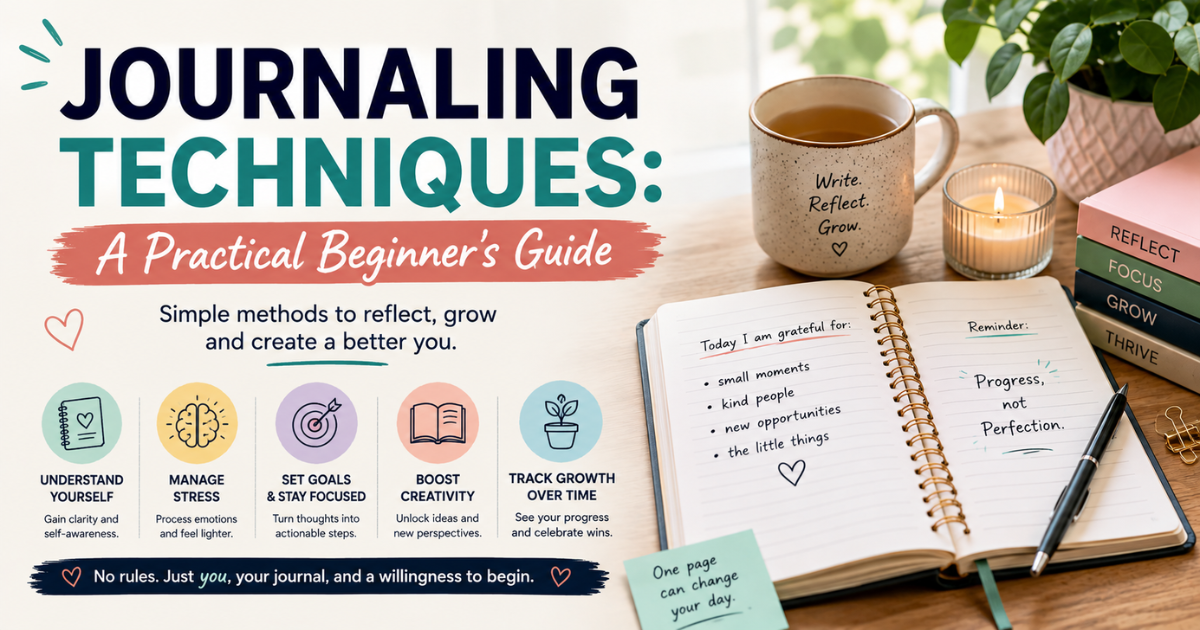
Journaling does not require elegant writing, an expensive notebook, or an hour of free time. At its simplest, it means recording your thoughts, experiences, questions, or plans. The difficult part is rarely writing itself. Most beginners struggle because they do not know what to write or believe every entry must be meaningful.
The right journaling techniques remove that pressure. Instead of forcing yourself to fill several pages, you can choose a method that serves a specific purpose. You might write to process an emotion, make a decision, track a goal, or remember your day. This guide will help you choose a practical method and build a routine you can maintain.
What Is Journaling and Why Is It Useful?
Journaling is the practice of recording thoughts, feelings, observations, or activities on paper or digitally. Unlike formal writing, a journal does not need to follow grammar rules or impress an audience. It can contain full paragraphs, unfinished sentences, lists, drawings, questions, or a few words describing your current mood.
People use journals for different reasons. Some want greater self-awareness, while others need a private place to organize complicated thoughts. Journaling may also help people recognize patterns in their moods, habits, relationships, and decisions. The University of Rochester Medical Center identifies managing anxiety, reducing stress, and coping with depression as potential benefits of journal writing. However, journaling should support—not replace—professional mental health care when it is needed.
Common reasons to keep a journal include:
- Processing thoughts and emotions
- Recording important memories
- Practicing gratitude
- Planning goals and next steps
- Monitoring habits or symptoms
- Improving creative thinking
- Preparing for difficult conversations
- Reflecting on personal progress
How to Start a Journaling Practice
Start with the format you are most likely to use. A paper notebook offers fewer distractions and gives you complete freedom over the layout. A digital journal is easier to search, secure, and access from different locations. Voice notes can also work if writing feels slow or physically difficult. There is no universally superior format.
Next, make the routine small enough to repeat. Begin with five minutes or three sentences rather than promising to write several pages every day. Keep your notebook visible or place a digital-journal shortcut on your phone’s home screen. Connect the habit to an existing routine, such as drinking morning coffee, finishing work, or getting ready for bed.
Use this simple process for your first entry:
- Write the date and your current mood.
- Describe what is taking up most of your attention.
- Explain why it matters to you.
- Identify one feeling, question, or possible next step.
- Stop when you have said what you need to say.
Your first entry might be as simple as: “I feel distracted because I have several unfinished tasks. I am worried I will forget something important. Tomorrow, I will write a short priority list before opening my email.”
Journaling Techniques for Different Goals
Different methods produce different kinds of entries. Stream-of-consciousness writing works well when your mind feels crowded. You write continuously for a set period without correcting grammar or organizing your ideas. Gratitude journaling is more focused. You record a few things you appreciate and explain why they were meaningful instead of producing a shallow list.
Reflective journaling helps you examine an experience after it happens. You describe the event, your reaction, what you learned, and what you might do differently. Bullet journaling uses brief notes, symbols, calendars, and task lists to combine reflection with planning. Expressive writing focuses more directly on stressful or emotionally significant experiences and may feel more intense.
| Technique | Best used for | Simple starting point |
|---|---|---|
| Free writing | Clearing a busy mind | Write without stopping for five minutes |
| Gratitude journal | Noticing positive experiences | Describe three specific things you value |
| Reflective writing | Learning from an event | Explain what happened and what you learned |
| Bullet journaling | Planning and habit tracking | List tasks, events, and short notes |
| Expressive writing | Exploring difficult emotions | Write honestly about one stressful experience |
| Goal journaling | Tracking progress | Record one goal, obstacle, and next action |
| Prompt journaling | Overcoming a blank page | Answer one focused question |
Harvard Health notes that expressive writing may help people organize their thoughts and give meaning to difficult experiences, though writing about painful subjects can initially feel upsetting. Start carefully, take breaks, and seek qualified support if writing repeatedly increases distress.
How to Choose the Right Journaling Method
Choose a method based on the problem you want to solve. If you feel mentally overloaded, try free writing. If you want to manage tasks, use bullet journaling. A gratitude journal may suit someone who wants to pay more attention to positive moments, while reflective writing works better for reviewing decisions, conflicts, or lessons.
You do not need to commit to one technique permanently. Test a method for a week and notice whether it makes writing easier or more useful. If the format becomes tedious, shorten it, combine it with another method, or replace it. A journaling practice should adapt to your needs instead of becoming another obligation.
Use this decision checklist:
- Do I want reflection, planning, emotional expression, or memory keeping?
- Do I prefer open-ended writing or clear prompts?
- How much time can I realistically give this?
- Would paper, typing, or voice recording be easiest?
- Do I need additional privacy or password protection?
- Do I feel calmer, clearer, or better organized afterward?
Helpful Journal Prompts for Beginners
Journal prompts provide direction when you cannot think of a subject. A useful prompt should be specific enough to start your thinking but broad enough to allow an honest answer. You do not need to answer every part of a question. Follow whichever idea feels most relevant and let the entry develop naturally.
Avoid treating prompts like school assignments. There is no correct response, required length, or grading standard. You can write one sentence, create a list, or explore the same question several times. Repeating a prompt can reveal how your thinking changes as your situation develops.
Try these beginner-friendly prompts:
Self-reflection prompts
- What has been taking up most of my mental energy?
- When did I feel most like myself this week?
- What am I avoiding, and what makes it difficult?
- Which recent decision am I proud of?
- What do I need more or less of right now?
Stress and emotion prompts
- What exactly am I worried might happen?
- Which part of this situation can I influence?
- What would I say to a friend facing this problem?
- Where do I notice tension in my body?
- What would help me feel supported today?
Goal and growth prompts
- What is one realistic goal for this week?
- What obstacle is most likely to stop me?
- What is the smallest useful next step?
- Which habit is helping me move forward?
- What lesson do I want to remember from today?
How to Make Journaling a Consistent Habit
Consistency comes from reducing friction, not relying on motivation. Keep your journal easy to reach and decide when you are most likely to use it. A fixed cue can help: write after breakfast, during a lunch break, or before turning off the lights. Set a five-minute timer if you tend to overthink the task.
Daily journaling is optional. Three useful entries per week can be more valuable than seven rushed ones. Missing a day does not erase your progress, and you do not need to “catch up.” Simply begin with the present moment. The goal is to create a tool you return to when it is useful.
A sustainable routine might look like this:
- Choose one dependable time or trigger.
- Keep the journal visible and accessible.
- Start with three sentences or five minutes.
- Use a prompt when you feel stuck.
- Review previous entries once a month.
- Adjust the method when your goals change.
Watch for common mistakes. Do not turn every entry into a polished essay, force yourself to write when exhausted, or judge your thoughts while recording them. Avoid using your journal only to repeat the same fear without examining evidence, alternatives, or next steps. If writing becomes relentless rumination, pause and consider discussing the issue with a licensed mental health professional.
Frequently Asked Questions
What is the best journaling technique for beginners?
Free writing and prompt-based journaling are strong starting options. Free writing lets you record whatever comes to mind, while prompts provide structure when you feel stuck. Try each method for several days and choose the one that feels more natural.
How long should I journal each day?
Start with five minutes. This is long enough to develop a thought but short enough to fit into most routines. You can continue when you have more to say. There is no evidence-based rule requiring several pages or a fixed daily word count.
Is it better to journal in the morning or at night?
Morning journaling can help you organize your priorities and notice your starting mood. Evening writing is useful for reviewing events and processing emotions. Choose the time when you have enough privacy and attention to write honestly.
Can I journal on my phone?
Yes. A phone, tablet, or computer can be just as practical as a notebook. Use a password-protected app if privacy is a concern. Turn off notifications during the session so other apps do not interrupt your thinking.
What should I do when journaling feels uncomfortable?
Slow down or stop. Write about a neutral subject, shorten the session, or switch to a simple list. Difficult feelings can arise during expressive writing, but you do not have to push through overwhelming distress. Seek professional support if the discomfort is severe, persistent, or connected to trauma.
Conclusion
The most useful journaling techniques are not necessarily the most elaborate ones. Free writing, reflection, gratitude lists, prompts, and bullet journaling can all work when they match a clear personal goal.
Start with one method, write for five minutes, and adjust the practice based on what helps. A journal should create clarity or useful insight—not pressure to perform. Google rankings cannot be guaranteed by any article alone, but clear search-intent alignment, credible sourcing, original examples, and genuine reader value give this page a sound SEO foundation.
