
Most people start a new habit with big energy and quit within a few weeks. That pattern is not a character flaw. It is a design problem. If you want to know how to build good habits that last, you need a simple system, not a burst of motivation. This guide breaks down the science, the steps, and the common traps in plain language.
You will learn how habits form, how to start small, and how to stay consistent when life gets busy. You will also find tables, a checklist, and real examples you can use today. Whether you want to exercise more, read daily, or save money, the same principles apply. Pick one habit as you read, and build it as you go.
What Good Habits Are and Why They Matter
A habit is a behavior you repeat so often that it runs on autopilot. Brushing your teeth is a habit. So is grabbing your phone the moment you wake up. Good habits support your health, money, relationships, and goals. Bad habits quietly work against them. The difference comes down to what you repeat, because small actions compound over months and years.
Habit researchers, including Wendy Wood at the University of Southern California, estimate that roughly 43 percent of everyday actions are habitual. That means your routines shape your life more than your big decisions do. When you understand how to build good habits, you stop leaning on willpower, which runs out, and start leaning on structure, which does not. Structure works even on tired days.
How Habits Form: The Habit Loop
Journalist Charles Duhigg popularized the habit loop in his book The Power of Habit. The loop has three parts: a cue, a routine, and a reward. The cue triggers the behavior. The routine is the behavior itself. The reward tells your brain the loop is worth repeating. After enough repetitions, the whole loop runs without much thought. Here is how it looks in practice.
| Loop Stage | What It Does | Example |
|---|---|---|
| Cue | Triggers the behavior | Your morning alarm goes off |
| Routine | The action you take | You put on shoes and walk 10 minutes |
| Reward | Makes your brain want a repeat | You enjoy a coffee and a sense of progress |
James Clear builds on this model in Atomic Habits with four laws: make it obvious, attractive, easy, and satisfying. Each law supports a stage of the loop. When a habit keeps failing, check which stage is weak. Maybe the cue is easy to miss, or the routine takes too much effort. Fixing one weak link often fixes the whole chain.
How to Build Good Habits Step by Step
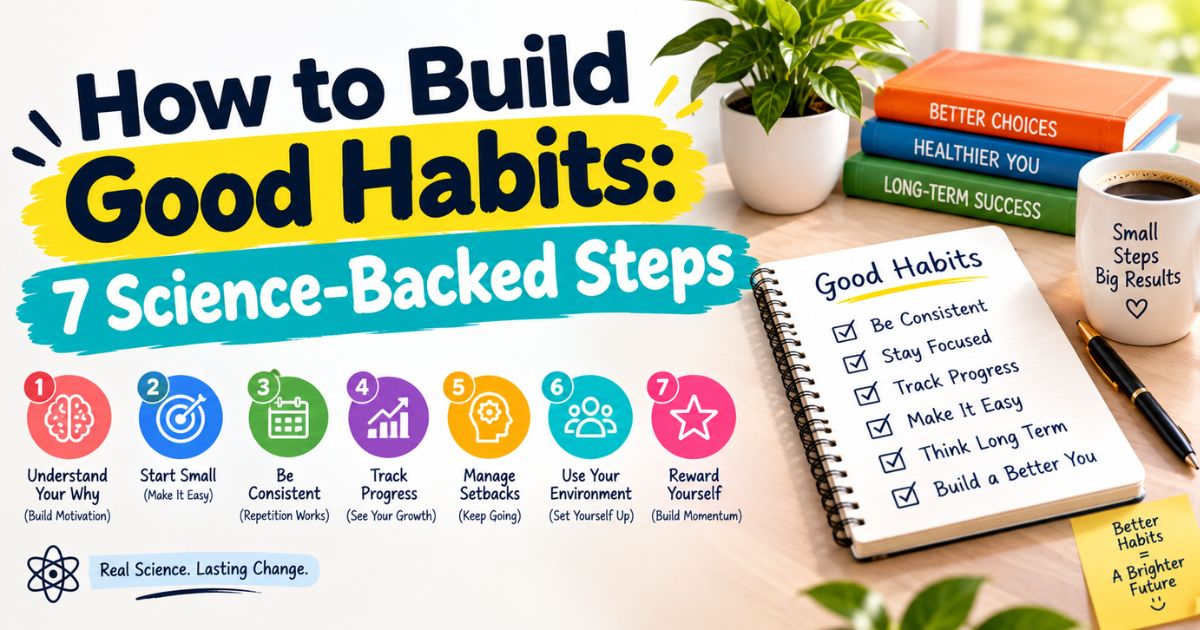
You do not need a complicated plan. You need a clear one. Follow these steps in order, and give each one a few days before moving on. The goal is to make the new behavior so easy and so predictable that skipping it feels strange. Start with just one habit. Trying to change five things at once is the fastest way to fail.
- Choose one habit. Pick the behavior that matters most right now.
- Make it specific. Replace “exercise more” with “walk for 10 minutes after lunch.”
- Start tiny. Shrink the habit until it feels almost too easy.
- Attach a cue. Link it to something you already do every day.
- Set up your space. Remove friction and put reminders in plain sight.
- Track your progress. Mark each success on a calendar or app.
- Review weekly. Adjust what is not working, then increase the difficulty slowly.
Here is an example. Say you want to read more. Instead of vowing to read for an hour each night, you decide to read one page after you pour your evening tea. You keep the book on your pillow. You mark an X on a calendar each night. Within weeks, one page often becomes ten, because starting was always the hard part.
Proven Strategies to Make Good Habits Stick
Once the basics are in place, a few proven techniques can make your habits much harder to break. These strategies work because they reduce friction and rely on cues already in your day. Use one or two at a time rather than all of them at once. Below are the three most reliable methods, followed by a quick comparison.
Habit Stacking
Habit stacking means attaching a new habit to one you already do. The formula is simple: “After I [current habit], I will [new habit].” For example, after I brush my teeth, I will floss one tooth. Your existing habit acts as the cue, so you do not need to remember anything new. BJ Fogg, who founded the Behavior Design Lab at Stanford, teaches a similar approach in his Tiny Habits method.
The Two-Minute Rule
The two-minute rule says to scale any habit down to something that takes two minutes or less. Read one page. Put on your running shoes. Open your budget app. This sounds trivial, but it removes the resistance that stops most people. Once you start, you often keep going. Even if you stop, you kept the streak alive, and consistency matters more than intensity early on.
Environment Design
Your surroundings can quietly make or break a habit. If you want to eat more fruit, put it on the counter. If you want to scroll less, charge your phone in another room. Make the good behavior obvious and the bad one inconvenient. Small changes to your space beat big promises to yourself because the environment works even when your motivation does not.
| Strategy | Best For | Effort Level | Quick Example |
|---|---|---|---|
| Habit stacking | Daily routines | Low | After coffee, write one to-do list |
| Two-minute rule | Overcoming procrastination | Very low | Open the document and write one sentence |
| Environment design | Cutting friction and temptation | Medium | Lay out workout clothes the night before |
How Long Does It Take to Build a Habit?
You may have heard that habits take 21 days. That number is a popular claim, not solid research. A well-known 2009 study from University College London, led by Phillippa Lally, followed 96 people as they built a new daily habit. On average, it took 66 days for the behavior to feel automatic. The range was huge, from 18 to 254 days.
The takeaway is encouraging. Simple habits, like drinking water with lunch, took less time than harder ones, like doing sit-ups. Missing a single day did not ruin progress either. So give yourself two to three months, expect uneven days, and focus on getting back on track quickly. Treat any slip as data, not failure.
Common Mistakes When Building Good Habits
Most habit failures follow the same few patterns. People aim too big, rely on motivation, or skip a clear cue. Others track nothing and then wonder why progress stalled. The good news is that each mistake has a simple fix. Spot your pattern first, and you can adjust your plan before frustration builds. The table below pairs each common problem with a practical solution.
| Mistake | Why It Fails | Better Approach |
|---|---|---|
| Starting too big | Effort is too high to sustain | Shrink the habit to two minutes |
| Relying on motivation | Motivation fades quickly | Use cues and a prepared environment |
| Vague goals | No clear trigger or finish line | State exactly when, where, and what |
| Changing too much at once | Attention gets spread thin | Focus on one habit at a time |
| Skipping tracking | No feedback on progress | Mark each day on a calendar or app |
Also, be kind to yourself when you slip. Beating yourself up rarely brings the habit back. A calm reset does. Ask what got in the way, adjust the plan, and try again tomorrow. A good rule is to never miss twice in a row. One missed day is an accident. Two days starts a new pattern.
Good Habit Ideas to Start With
If you are not sure where to begin, choose a habit tied to a goal you care about. Starting with something meaningful keeps you engaged when the novelty fades. The table below shows common good habits across four areas, along with a tiny starting version you can try this week. Notice how small each one is. That is intentional, and small wins build confidence.
| Area | Good Habit | Tiny Starting Version |
|---|---|---|
| Health | Daily movement | Walk for five minutes after dinner |
| Productivity | Planning your day | Write three priorities each morning |
| Finance | Tracking spending | Review one day of purchases each evening |
| Mindset | Reflection | Write one sentence in a journal before bed |
Before you begin, run through the checklist below. It takes two minutes and can save you weeks of trial and error. If you can check every box, your odds of sticking with the habit improve. If you cannot, simplify the habit until you can. Clarity beats ambition every time. Review it again after one week.
- I chose only one habit
- I wrote it as a specific action
- It takes two minutes or less to start
- I linked it to an existing daily cue
- I prepared my space
- I have a way to track each day
Frequently Asked Questions
These are the questions people ask most often about forming new routines. Each answer is short, so you can scan quickly and get back to building your habit. If your situation is more complex, such as a habit tied to a health condition, talk with a doctor or qualified professional before making big changes. Consistency, not intensity, is the common thread.
How do you build a habit from scratch?
Choose one specific action, shrink it to two minutes, and attach it to something you already do daily. Track each success and review weekly. Repeat it in the same place at the same time. Over weeks, the behavior becomes automatic, and you can slowly make it longer or harder.
Is it really 21 days to build a habit?
No. The 21-day idea is a popular claim, not a research finding. A University College London study found an average of 66 days, with a range from 18 to 254 days. Plan for about two to three months, and expect the timeline to vary by habit and person.
Why can’t I stick to good habits?
The usual causes are goals that are too big, no clear cue, and reliance on motivation. Shrink the habit, tie it to an existing routine, and prepare your environment. Also, avoid missing two days in a row. Fixing the system almost always works better than trying harder.
What is the easiest way to start a new habit?
Use habit stacking with a tiny action. After you pour your morning coffee, do one push-up or write one sentence. The existing routine gives you a built-in cue, and the small size removes resistance. Once the action feels easy, increase it gradually.
Conclusion
Learning how to build good habits comes down to a few clear ideas. Start with one habit, make it tiny, and attach it to a cue you already have. Shape your environment so the right action is easy. Track your progress, review each week, and expect it to take about two to three months.
Do not chase perfection. Missed days happen, and a calm reset beats guilt every time. Choose your habit today, write down your cue, and do the two-minute version tonight. Small, repeated actions are what change your life. Now you know how to build good habits that last, so start with one.
