
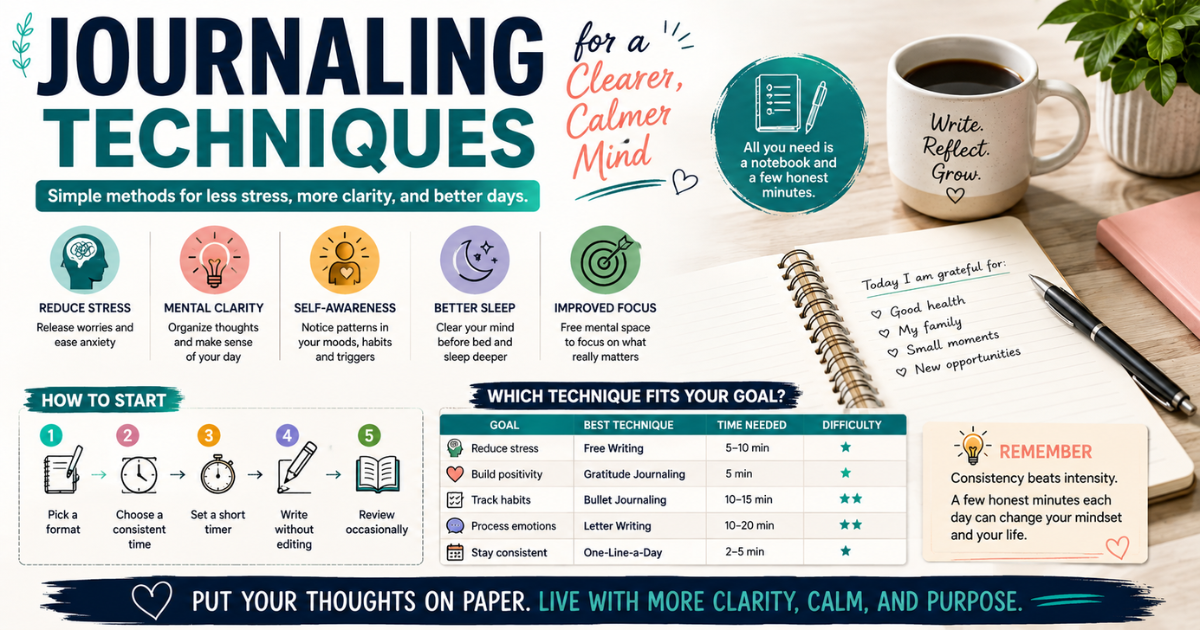
Your mind can only hold so much before it starts to feel cluttered. Between work deadlines, family obligations, and a constant stream of notifications, it’s easy to feel scattered by mid-morning. Journaling techniques offer a simple, low-cost way to clear that mental noise. Instead of letting thoughts loop endlessly in your head, you put them on paper, where you can look at them, sort through them, and let some of them go.
This guide breaks down beginner-friendly and advanced methods for stress relief, anxiety, and self-reflection, plus a comparison table to help you pick the right approach for your goals. You’ll find step-by-step instructions and real examples along the way. No writing talent required — just a notebook and a few honest minutes.
What Are Journaling Techniques and Why They Matter
Journaling techniques are structured methods for writing down your thoughts, feelings, and experiences with a specific purpose in mind. Unlike a plain diary entry that just logs your day, these techniques guide what you write and why. Some focus on gratitude, some on problem-solving, and others on simply emptying a busy mind before bed. That structure is what turns journaling from a casual habit into a genuine mental wellness tool.
Writing by hand slows down racing thoughts in a way that typing rarely does. Researchers have studied expressive writing for decades, and the pattern holds up: putting emotions into words can ease stress, improve mood, and support better sleep. This kind of writing also builds self-awareness over time. When you look back at old entries, you start noticing patterns — what triggers stress, what actually makes you happy, and what you keep avoiding.
| Benefit | How Journaling Helps |
|---|---|
| Stress relief | Putting worries on paper reduces mental repetition and racing thoughts |
| Mental clarity | Organizes scattered ideas into clear, readable steps |
| Emotional awareness | Reveals patterns in mood and triggers over time |
| Better sleep | Clears the mind before bed and reduces nighttime overthinking |
| Improved focus | Frees up mental space by getting tasks and worries out of your head |
How to Start a Journaling Practice That Sticks
Starting is simpler than most people expect. You don’t need special training, a fancy notebook, or a perfect opening line. All you need is five to ten quiet minutes and something to write with, whether that’s a spiral notebook or a notes app on your phone. The goal isn’t perfect grammar or beautiful handwriting — it’s getting your thoughts out of your head and onto a page where you can deal with them.
- Pick a format: a notebook, an app, or loose paper all work fine.
- Choose a consistent time: morning pages or a nightly wind-down both work well.
- Set a short timer: five to ten minutes is plenty when you’re starting out.
- Write without editing: skip the spelling and grammar checks completely.
- Review occasionally: reread old entries once a week to spot patterns.
Once the basics feel comfortable, most beginners run into the same question: how long should each session actually be? The honest answer is shorter than most people expect. Treating journaling like a homework assignment with a strict time requirement is one of the fastest ways to abandon the habit within a week.
How Long Should You Journal Each Day?
Five to ten minutes a day is enough to see real benefits. Consistency matters more than length — a short daily entry beats one long session written once a month. As the habit builds, you can stretch sessions to fifteen or twenty minutes if you want to explore prompts in more depth.
Popular Journaling Techniques for Beginners
Not every technique fits every person, and that’s fine. The best approach for beginners is to try a few different methods and notice which one feels natural. Some people love the freedom of writing whatever comes to mind. Others prefer structure, like a specific prompt or checklist to follow each day. Below are three of the most beginner-friendly journaling techniques, each with a different focus and format.
Free Writing (Stream-of-Consciousness Journaling)
Free writing means putting pen to paper and writing whatever comes to mind, without stopping to edit or judge it. Set a timer for five minutes and keep your hand moving the whole time, even if you end up writing “I don’t know what to write” a few times. This method works well for clearing mental clutter fast, especially first thing in the morning before your inner critic wakes up.
Gratitude Journaling
Gratitude journaling asks you to write down a few things you’re thankful for, ideally with a short reason why. Instead of “I’m grateful for my family,” try “I’m grateful my sister called just to check in — it made a hard day easier.” Specific entries train your brain to notice good moments as they happen, not just when you sit down to write about them.
Bullet Journaling
Bullet journaling combines planning and reflection using short symbols and lists instead of full sentences. A dot might mean a task, a circle an event, and a dash a note. It works well for people who think in lists rather than paragraphs, and it doubles as a planner, tracker, and journal in one notebook.
A few simple prompts to try with any of these methods:
- What’s one thing that went well today?
- What’s currently taking up the most space in my mind?
- What am I avoiding, and why?
- What would make tomorrow feel easier?
Journaling Methods for Stress and Anxiety Relief
When stress builds up, thoughts tend to spiral instead of resolve. Journaling techniques designed specifically for stress and anxiety give those spiraling thoughts somewhere to go besides around in circles. Rather than general reflection, these methods focus on getting worries out of your head quickly and, when needed, questioning whether those worries are as accurate as they feel. They’re especially useful during busy weeks, before big decisions, or right before bed when your mind won’t slow down.
The Brain Dump Method
The brain dump method is exactly what it sounds like: you write down every thought, task, and worry crowding your mind, with no filter and no particular order. Set a timer for ten minutes and let it all spill out — unfinished emails, nagging errands, random anxieties. Once it’s on paper, sort the list into “needs action,” “can wait,” and “not actually in my control.”
Worry Journaling and Cognitive Reframing
Worry journaling takes things a step further by challenging anxious thoughts instead of just recording them. Write down the worry, then ask: Is this based on fact or fear? What’s the most likely outcome, not the worst-case one? This process, often called cognitive reframing, helps separate real problems from anxious “what ifs,” which can make anxiety feel far less overwhelming.
Can Journaling Really Help With Anxiety?
Journaling can meaningfully ease everyday anxiety by giving racing thoughts a place to land and slowing down reactive thinking. It’s not a replacement for professional treatment, though. If anxiety feels constant, intense, or hard to manage alone, journaling works best alongside support from a therapist or counselor, not instead of it.
Advanced Journaling Practices for Deeper Reflection
Once daily journaling feels natural, you can explore techniques built for deeper insight rather than quick relief. These approaches take a little more time and honesty, but they pay off with a clearer sense of your values, goals, and recurring patterns. They work well once or twice a week, layered on top of a simpler daily habit like gratitude or free writing.
Prompt-Based Journaling
Prompt-based journaling uses a specific question to guide each entry instead of a blank page. Prompts remove the “what do I even write about” hurdle and push you toward topics you might otherwise avoid. Try prompts like:
- What’s one belief I hold that might not actually be true?
- Where do I feel the most energized during my week?
- What conversation have I been avoiding, and why?
- What would I do differently if I weren’t afraid of judgment?
The Five-Minute Journal Method
The five-minute journal method splits entries into a quick morning and evening check-in. In the morning, jot down three things you’re grateful for and one goal for the day. At night, note one win and one lesson learned. It’s fast, repeatable, and gives your day a clear beginning and end.
Evening Reflection Journaling
Evening reflection journaling looks back on the day before you sleep, focusing on what happened, how you felt, and what you’d adjust tomorrow. This technique helps close mental “open loops” so your brain isn’t still processing the day’s events at 2 a.m. Keep it short: three or four sentences is often enough to feel the benefit.
Choosing the Right Technique for Your Goals
With so many journaling techniques available, picking one can feel overwhelming. The truth is, the “best” technique depends entirely on what you’re trying to solve. Someone dealing with racing thoughts at night needs a different approach than someone trying to build long-term self-awareness. Use the comparison below to match a method to your goal, then adjust as your needs change.
| Technique | Best For | Time Needed | Difficulty |
|---|---|---|---|
| Free writing | Clearing mental clutter fast | 5 minutes | Easy |
| Gratitude journaling | Boosting mood and positivity | 5 minutes | Easy |
| Bullet journaling | Planning and quick tracking | 5–10 minutes | Easy |
| Brain dump method | Reducing overwhelm and stress | 10 minutes | Easy |
| Worry journaling | Managing anxious thoughts | 10–15 minutes | Moderate |
| Prompt-based journaling | Deeper self-reflection | 10–15 minutes | Moderate |
| Five-minute journal | Building a daily habit | 5 minutes, twice daily | Easy |
If you’re brand new, start with free writing or gratitude journaling since both take just a few minutes and require zero structure. If stress or anxiety is your main concern, the brain dump method or worry journaling will feel more useful right away. Once you’ve built a steady habit, layer in prompt-based journaling for a deeper look at your patterns and goals.
Avoiding Mistakes and Building a Lasting Habit
Most people don’t quit journaling because the technique doesn’t work. They quit because of avoidable mistakes. Trying to write a perfect entry every time, setting unrealistic goals like a full page daily, or skipping a day and treating it as total failure are the most common habit-killers. These methods are meant to be flexible tools, not strict assignments with grades attached. Treat missed days as normal, not as a reason to stop entirely.
Common Mistakes to Avoid
- Waiting for the “right” mood or moment to write
- Judging your grammar, spelling, or handwriting
- Trying to journal for 30-plus minutes right out of the gate
- Skipping entries after missing one day, instead of just restarting
- Using journaling only during a crisis instead of building a routine
Checklist for Staying Consistent
- Keep your notebook or app somewhere visible
- Attach journaling to an existing habit, like morning coffee
- Start with 5 minutes, not 30
- Pick one technique and stick with it for two weeks before switching
- Review entries weekly to notice progress and patterns
Consistency beats intensity every time. A five-minute entry every day builds more insight over a month than one long session written out of guilt. Pair your chosen technique with a trigger you already do daily, like brewing coffee or brushing your teeth before bed, and the habit sticks with far less willpower required.
Final Thoughts on Building a Calmer Mind
A clearer, calmer mind doesn’t require a total lifestyle overhaul. It often starts with a notebook and five honest minutes. Whether you choose free writing, gratitude journaling, or a structured brain dump, the goal stays the same: get your thoughts out of your head and onto paper, where they’re easier to understand and let go of.
Start with one journaling technique this week, and give it a few days before judging whether it works. Notice how much lighter your mind feels after even a short session. The best journaling techniques aren’t complicated or time-consuming. They just have to be consistent, honest, and truly yours.
